Atelier

Istanbul, Beykoz. An atelier — where time slows down.

The Beykoz atelier — morning light
Ahmet Rıdvan açık havada, sisli bir orman ve göl manzarasının önünde uzağa bakıyor. Siyah-beyaz fotoğraf.

A Craft, A Decision

Like everyone else, I was waiting at the door of an exam.

In my university years, I was trying to anchor uncertainty to a steady job — as everyone around me did. But something else was burning inside: a passion for making, a fire I chose to feed rather than extinguish.

One day, while reading through old documents on Islamic arts, I stumbled upon a fragment of knowledge — notes on how the materials behind these arts were made. I searched. I asked whether anyone still practiced this. And I found my master.

The Great Master Hezarfen İbrahim Sami Özen did not simply teach me a craft. He taught me to extract pigments from earth, to make traditional ink, to shape brushes from feathers — the quiet knowledge that underlies the classical arts. But what took hold of me most deeply was hidden within all of it: paper.

I learned paper-making in its every detail. With my master’s blessing, I opened my first 40 m² atelier in Kadıköy. Today I work in a two-storey space. But what truly changed was not the room outside — it was the decision within.

The Maker

Ahmet Rıdvan

Artisan Papermaker, Istanbul

His connection to Islamic arts came through lineage: a sensibility inherited from the family of the great calligraphy master Hasan Çelebi. That sensibility grew into curiosity, and curiosity into a way of life.

He was trained through the traditional master-apprentice relationship — a deliberate choice, given that no institution in Turkey yet teaches the craft of hand papermaking. He deepened his knowledge of Turkish-Islamic arts through a graduate degree in the History of Islamic Arts at Marmara University.

His expertise lies in calligraphy — in reading and evaluating works, and in the material knowledge that underpins them. He continues the traditional training method known as meşk to this day.

Ten years within this craft, eight years of active production. Lart Works was born not as a commercial venture, but as the artistic expression of this accumulated knowledge.

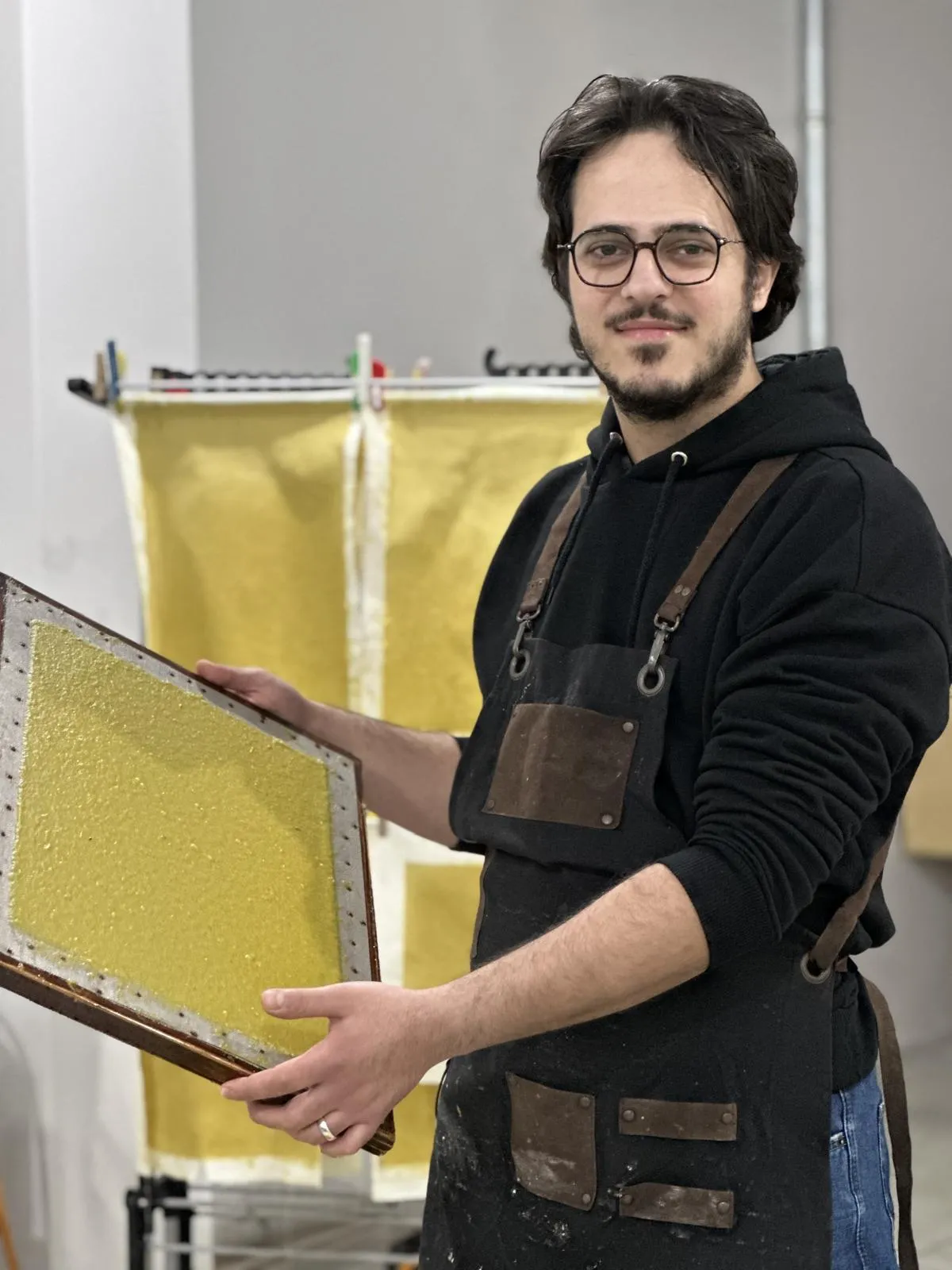
Ahmet Rıdvan atölyesinde, üzerinde sarı kâğıt hamuru bulunan bir eleği iki eliyle tutuyor. Arkasında kuruyan kâğıt tabakaları asılı duruyor.

Lineage

A civilization of writing, and its debt to paper

The Turks have been entwined with the history of paper for more than two thousand years. But what deepened this relationship was not the material alone — paper was the very medium through which Muslim Turkish civilization expressed its relationship with art and knowledge. The Ottoman Empire was, above all, a civilization of writing. Calligraphy, illumination, marbling, miniature — all these arts were inscribed in paper, preserved by paper, and carried to the present day through paper.

There is a reason why the works left by our ancestors remain legible, visible, and touchable today: they were made with genuine materials, produced from natural sources. Non-toxic pigments, traditional inks, and handmade papers — this triad formed a shield against time.

Today, the picture is different. The majority of contemporary artists work with industrial and toxic materials. This is not merely a matter of aesthetic choice — it is a question of permanence.

This is where Lart Works stands. Paper produced through traditional methods carries both the means and the meaning of cultural transmission. We do not simply make paper — we allow the knowledge left by our ancestors to speak again, in the language of contemporary design.

How We Produce

Two philosophies, one atelier.

From Nature to Paper

Linen, hemp, cotton, mulberry. These high-cellulose raw materials are processed through traditional methods to form the skeletal structure of our artisan papers. Both Eastern and European papermaking techniques are applied in production — because paper has always been a knowledge without borders.

From Discard to Distinction

Quality printing waste and textile production offcuts are carefully selected and gathered — not as industrial residue, but as unprocessed raw material. These materials are integrated into hand papermaking to become the surfaces of our premium printed products.

Time

The life of a sheet

In our atelier, time is not a production variable — it is a material component.

Some artisan papers require two years to mature before they are truly ready for use. They are treated through traditional techniques, then left to rest. And rest. And rest again. Some need six months; some, a week. An impatient hand cannot touch these papers.

On the upcycling line, the rhythm is different. For a quality waste sheet to become a surface ready for letterpress printing, two days are sufficient.

This difference is not a question of speed. Every paper has its own time — and we respect that time.

  1. Two days The upcycling line — a surface ready for letterpress
  2. One week The fastest-maturing artisan sheets
  3. Six months Mid-term treatment
  4. Two years Full maturation

Vision

Lart Works exists not to grow larger — but to grow deeper.

Nationally, we aim to be the first name that comes to mind when bespoke, artistic production is the question. Not merely as a maker — but as an atelier that generates solutions for design-led projects and brings its own perspective to luxury and creative processes.

Internationally, we seek partnerships with recognized brands across sectors, carrying the paper knowledge of Anatolia and the authority of handcraft into design projects worldwide.

On a more distant horizon, there is another vision: an atelier-museum that brings together the history of paper, its production processes, and the cultural heritage of this craft within a living space. A place where making and memory exist beneath the same roof.

The atelier, for us, is always a point of departure — never of arrival.